How Do You Record a Live Podcast in Front of an Audience?
By Greg McVeigh PR Guest House Projects · Reviewed by Ash Levitt, CEO · Updated October 7, 2026
TL;DR: For a live podcast in any room, from a 50-seat bar to a 50,000-seat arena, put a dynamic microphone in front of every host, record each mic to its own track, and take a backup mix from the venue’s sound desk. Dynamic mics like the Heil PR 40, PR 30 and PR 37 reject the PA, the crowd and the bar noise that a condenser mic picks up. Place stage monitors where your mic is least sensitive, rehearse the open and close, and give audience Q&A its own mic.
Who is this guide for?
This guide is for any podcast taking its show from the studio to a live audience: a brewery taproom, a comedy club, a theater, a conference stage or an arena. The same mic, monitor and recording rules apply whether 50 people are in the room or 50,000. At larger venues, share this page with the front-of-house engineer so your mic choices and their monitor plan match.
What microphone should you use to record a live podcast?
Use a dynamic cardioid or supercardioid microphone for every host. On stage, your mic hears the PA speakers, the monitors, the audience and the room, not just your voice. A dynamic mic is less sensitive than a condenser, so the voice 2–4 inches away dominates and everything else falls back.
Heil Sound’s PR-series dynamics are built for exactly this problem. Each has a published rear rejection of −40 dB at 180°, which means sound arriving from directly behind the mic is picked up 40 dB quieter than your voice in front of it. None of them need phantom power.
Why should you keep condenser mics off the hosts’ stands?
Our position: condensers belong in the studio, not in front of a host on a live stage. The sensitivity that makes a condenser sound detailed in a treated room makes it pick up the PA, the crowd and the espresso machine in a bar. It also feeds back sooner when the PA is turned up. Many home podcast setups use condensers, so this is the single most common change a show needs to make for its first live date.
Which Heil mic fits your live podcast: PR 40, PR 30 or PR 37?
Pick the PR 40 for the classic broadcast voice, the PR 30 for loud rooms and light boom arms, and the PR 37 for handheld and audience Q&A use.
| Mic | Pattern | Frequency response | Rear rejection | Max SPL | Weight | Price (Oct 2026) | Pick it if… |
|---|---|---|---|---|---|---|---|
| Heil PR 40 | Cardioid | 28 Hz–18 kHz | −40 dB at 180° | 148 dB | 13.5 oz | $379 | You want deep, full broadcast tone and hosts stay on a boom. Speak into the end, not the side. |
| Heil PR 30 | Supercardioid | 40 Hz–18 kHz | −40 dB at 180° | 146 dB | 9 oz | $299 | The room is loud and you want clear mid-range speech; light enough for a desk boom. |
| Heil PR 37 | Supercardioid | 40 Hz–18 kHz | −40 dB at 180° | 140 dB | 12.25 oz | $299 | You need a handheld for a roaming host or audience questions, or a mic that survives travel. |
How do you stop the PA and monitors bleeding into your recording?
Put every stage monitor where your mic’s pickup pattern is least sensitive. That angle depends on the pattern, which is why the mic choice and the stage layout have to be planned together.
- Cardioid (PR 40): least sensitive directly behind the mic (180°). Put the wedge on the floor in front of the host, aimed back at them; it sits behind the mic.
- Supercardioid (PR 30, PR 37): least sensitive at about 125° on each side, with a small pickup lobe directly behind. Angle wedges off to the sides, not straight behind the mic.
- Main PA speakers: keep them in front of the hosts’ line, never behind or beside the table.
- Floor Wedges are fine: Heil mics are used with floor wedges on live sound stages all the time. With the wedge in the zones above, the −40 dB rear rejection keeps the monitor out of the recording.
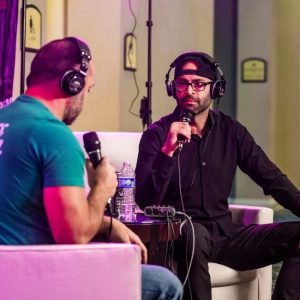
Andrew Zargoza interviewing speakers at the Silverback Summit 2025.
How do you record a live podcast so it can be edited afterward?
Record every mic on its own track, plus the audience, plus a backup. A stereo mix alone cannot be fixed if one host’s level is wrong.
- Run each host mic to its own input on a multitrack recorder, an audio interface, or the venue’s digital console with USB multitrack recording.
- Add two audience mics facing the crowd, on separate tracks, for laughter and applause.
- Ask the front-of-house engineer for a stereo board mix to a second recorder as a backup.
- Set levels at soundcheck with hosts talking at show volume; people speak louder in front of a crowd. Leave about 12 dB of headroom.
- Record at 48 kHz / 24-bit and clap once on mic at the start so the recorders can be synced in editing.
- Start recording when the doors open. Storage is cheap; a missed cold open is not.
How should hosts work the mic on a live stage?
Stay 2–4 inches from the mic, talk straight into its front, and keep that distance steady. Lean back slightly for big laughs or shouts so the level does not spike. Mount seated hosts’ mics on a boom with a shock mount, such as the Heil SB-2 or PL2T boom and PRSM shock mount, so table bumps and mug thumps do not reach the recording. Never pass a host mic around the room.
How do you run audience Q&A without ruining the recording?
Give the audience its own handheld mic on its own track, carried by a runner. A rugged handheld dynamic like the PR 37 suits this job. If someone asks a question off-mic, the host repeats it into their own mic before answering. Put a recording notice on tickets and at the door so attendees know they may be heard on the episode.
How do you plan a live show when there is no pause button?
Write a run of show with timed segments, and rehearse the open and close until they are automatic. Agree on non-verbal cues: small whiteboards or hand signals let hosts say “wrap it up” or “go to Q&A” without saying it on mic. Plan a buffer, such as a short set from a local act, to cover a late start or a technical reset.
What should you ask a venue before booking a live podcast?
Ask these before you sign; each answer changes your gear list.
- Is there a front-of-house engineer, and can they give you a multitrack or board feed?
- What is the noise floor during service: ice machines, coolers, espresso machines, TVs? Can any be switched off during the show?
- Where do the PA speakers sit relative to the stage?
- How many inputs does the house console have free for your mics?
- Does seating capacity match the audience you can realistically fill?
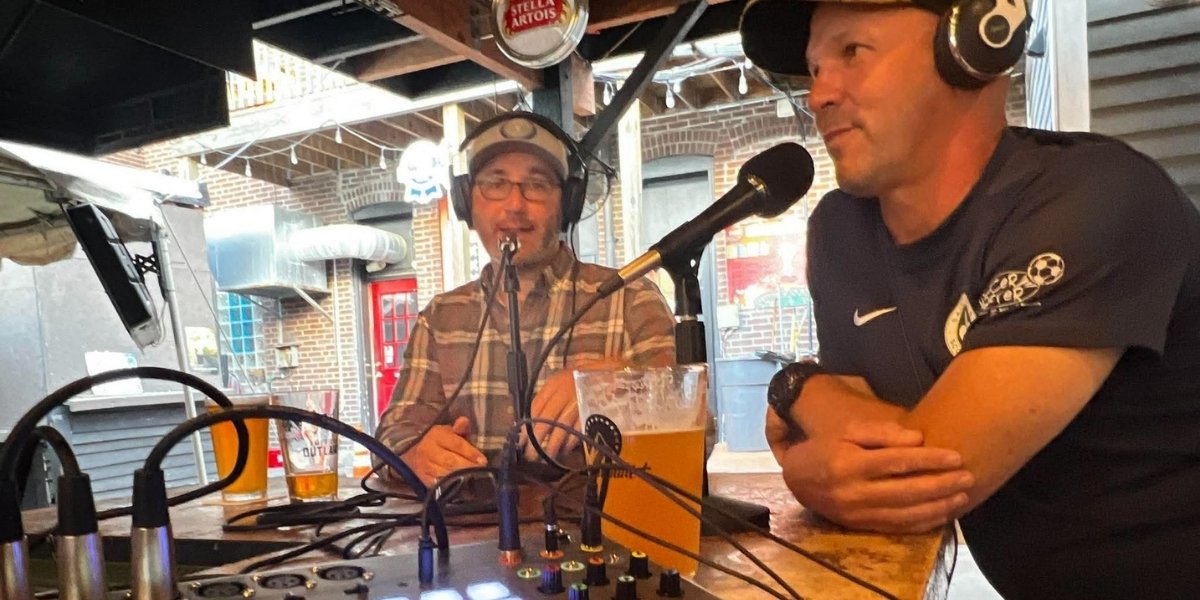
Example setup: a two-host show in a 120-seat brewery taproom. Two PR 40s on desk booms with shock mounts, one or two mic for audience noise/reactions, and one or two PR 37 handheld microphones for audience Q&A. The house PA stays in front of the stage. Make sure you are not aiming the microphone’s pick up pattern toward loud coolers or other loud equipment. Five (or more if you add the additional audience and Q&A mics) tracks go to the recorder while the engineer sends a board mix to a backup.
Which podcasts have recorded live on Heil microphones?
The Heil Sound podcast: 50 Years of Maximum Rock n’ Roll recorded live at the NAMM Show. It is known as one of the noisiest trade shows. Show Producer Michelle Levitt said, “We had so much isolation with our host and guest audio that we actually had to mix in ‘show noise’ to make sure the audio actually sounded like we were coming live from the NAMM Show.”
Why trust Heil Sound on live audio?
Heil Sound founder Bob Heil built touring sound systems for the Grateful Dead and The Who before designing microphones (Heil podcast). Heil says the PR 40 is used by satellite radio stations and pro sports announcers, the same broadcast settings where off-axis noise has to stay out of the mic.
Frequently asked questions
What is the best microphone for recording a live podcast?
A dynamic cardioid or supercardioid microphone for each host. Dynamic mics like the Heil PR 40, PR 30 and PR 37 pick up the voice a few inches away and reject the PA, the crowd and room noise that a condenser would capture.
Can I use a USB microphone for a live podcast?
It is not a good fit. A USB mic plugs into a computer, not into the venue’s mixer, so you can’t share its signal with the PA or the front-of-house engineer. Use XLR dynamic mics instead.
Does the Heil PR 40 need phantom power?
No. The PR 40 is a dynamic microphone, so it does not need phantom power or an inline preamp to work with a standard mixer.
How many microphones do I need for a live podcast?
One per host and guest, one handheld for audience questions, and optionally two audience mics for laughter and applause. Record each on its own track.
How far should I be from the microphone on stage?
About 2 to 4 inches, talking straight into the front of the mic. Keep that distance steady and lean back slightly for laughs or shouts.
Should I use a cardioid or supercardioid mic for a live podcast?
Both work. A cardioid mic like the PR 40 rejects most sound from directly behind, so put the stage monitor there. A supercardioid mic like the PR 30 or PR 37 has a tighter front pickup that helps in loud rooms; its quietest angles are about 125 degrees off-axis on each side, so angle monitors there.
Planning your first live show?
Tell us your venue, crowd size and number of hosts, and Heil Sound will help you choose mics and a stage layout. Contact Heil Sound or shop the PR 40, PR 30 and PR 37.